Wardogs T-72 Tank Explained
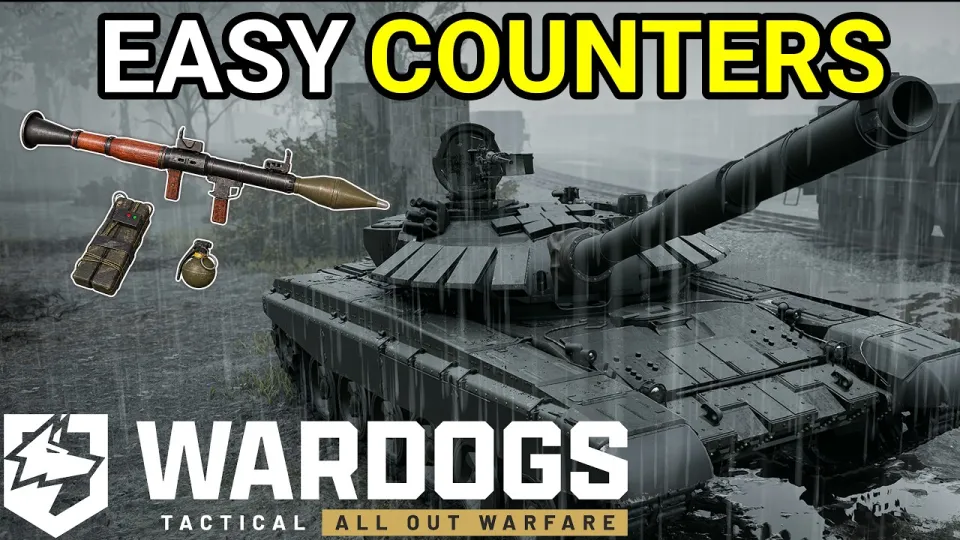
Video: Why Everyone Hates the T-72 Tank in WARDOGS
You can order the same kind of articles for your own video to boost it on YouTube and Google. Just message the Telegram bot @sat_sit_bot. The bot writes and publishes the articles itself (with your YouTube video embedded) on popular topical websites (no ads). Your first 50 articles are free.
· based on the channel Josephant
Key takeaways
- The T-72 in Wardogs is killable: RPG hits, C4 planted on the hull and grenades dropped from close range all deal damage to it.
- RPG splash damage registers inconsistently, so a near miss can hurt the tank more than a direct hit.
- The tank's third-person camera lets the driver spot infantry far earlier than a flanking player expects.
- Tanks are loud: engine noise is audible from roughly 150 meters, so a stationary tank is easier to avoid than to chase.
- Attack helicopters are gated behind a point threshold, while tanks are available from the first minutes of a match.
- A tank without infantry support dies quickly; a tank with a squad around it is the hardest target on the map.
The T-72 in Wardogs is not impossible to kill, but it is unforgiving: it rewards the player who brings the right tool and punishes the one who fires an RPG from the open at 80 meters. Direct RPG impacts, C4 placed on the hull and grenades thrown onto the engine deck all damage the tank, and a coordinated two-player attack kills it in seconds. What makes it feel overpowered is not its armor value but how early it unlocks, how far its third-person camera sees and how rarely random teammates carry a counter.
What the Wardogs T-72 tank actually is
The T-72 is the first main battle tank available in Wardogs and it sits at the top of the ground vehicle hierarchy above Humvees and light transports. It combines a heavy cannon with a coaxial machine gun, which means it can delete infantry, shred soft-skinned vehicles and hold a road junction on its own. Its real strength is not a single stat but the combination of mobility, a turret that rotates independently of the hull and a camera that sees over walls and around corners.
That camera is the most underrated part of the vehicle. A driver in third person spots a flanking player long before that player can line up a shot, which is why so many attempts to sneak up on a tank end with a face full of machine gun fire. Engine noise works against the crew, though: the tank is loud enough to be heard from roughly 150 meters, so a smart infantry player usually knows a T-72 is nearby before seeing it.
Why RPG hits on the T-72 feel so inconsistent
The RPG is the intended hard counter to the T-72, yet it is the weapon players complain about most, and the reason is damage registration rather than raw damage numbers. In practice, splash damage from a rocket that lands beside or under the tank often registers more reliably than a rocket that strikes the turret or the upper front plate. That produces the counterintuitive result where a near miss takes a visible chunk of health while a clean hit seems to do nothing.
Practical consequences for anyone hunting a tank:
- Aim at the hull sides and rear rather than the turret face; the profile is larger and the registration is more forgiving.
- Fire from cover and reposition immediately, because the muzzle flash and smoke give your position away to a third-person camera.
- Do not fire a single rocket and stand still to watch the result; the tank will rotate and kill you before the reload finishes.
- Expect two well-placed rockets from a single shooter to be enough to force a tank to disengage or die, provided both connect.
A related oddity is that the same rocket seems to hurt a Humvee less than it hurts a tank, which is a balance question rather than a skill question. Until that is tuned, treat the RPG as a disruption tool first and a killing tool second.
C4 and grenades: the close-range answers to a T-72
C4 is the most reliable infantry answer to a tank in Wardogs, and it does not require a lucky rocket angle. The routine is simple: approach from a direction the turret is not facing, plant the charge on the hull, back off and detonate. A logistics player carrying C4 in storage can switch roles mid-match and become a tank buster with a profit, which is exactly the kind of improvisation the game rewards.
Grenades are the budget version of the same idea and are more useful than most players expect. Because they can be thrown from further away than a player can reliably close to C4 range, they let you damage a tank from behind a wall or over a fence without exposing yourself. The damage is modest per grenade, but a handful landing on the engine deck adds up, and the tank crew usually cannot tell where they came from.
The catch is the approach. A tank sitting still with a driver watching the third-person view is genuinely hard to flank, and once it spots you it can reverse or drive off faster than an infantry player can chase. The trick is to attack a tank that is already distracted by another threat, ideally while it is trading fire with a vehicle or shelling a position.
Why the T-72 feels overpowered to most players
The complaints about the T-72 are less about its durability and more about timing and asymmetry. A tank can roll out within the opening minutes of a match, while the cleanest counter, the attack helicopter, is locked behind a point threshold. That gap means the first tank on the field often faces a team with nothing heavier than rifles, grenades and whatever RPGs happen to be in a squad.
Three factors drive the perception:
- Availability. Heavy assets arriving before counters exist creates a window where the tank is effectively uncontested.
- Asymmetry of attention. A tank crew is focused on hunting; a public-match team is usually scattered across the map doing unrelated things.
- Third-person vision. The driver sees over cover, which removes most of the stealth advantage infantry rely on.
The reverse experience is just as common: a player who finally gets into a tank finds two rockets incoming within a minute and dies before doing anything. That asymmetry, easy to farm with and easy to lose, is what makes the vehicle controversial rather than simply strong.
Do tanks need infantry support in Wardogs?
Yes, and this is the single biggest skill gap between a good T-72 crew and a dead one. Military doctrine has always paired tanks with infantry, and Wardogs reproduces that logic: a lone tank is vulnerable to anyone who gets behind it, while a tank surrounded by a few friendly players covering the flanks is extremely difficult to dislodge.
In practice, a supported tank works like this:
- The tank holds open ground and suppresses with the cannon and machine gun.
- Two or three infantry players watch the side streets and rooftops the turret cannot cover.
- Anyone who tries to plant C4 gets shot before reaching the hull.
- The tank pushes only after the infantry has cleared the buildings ahead.
The obstacle is player count and cooperation. Running a proper combined-arms group takes a full squad, and public matches rarely produce one. That is why the tank's power level is best judged by how it performs against an unorganized team, not against a coordinated one.
Typical questions from the Wardogs community
Several recurring doubts come up whenever the T-72 is discussed. The first is whether the tank should unlock at all in the opening minutes, or whether it should be gated behind the same point threshold that already restricts attack helicopters and heavy artillery. The second is whether the driver's third-person view gives too much information, since it lets a crew spot an approach before the attacker can even see the tank.
A third theme is progression: drivers who leveled the role early gained a large advantage, and some players deliberately stopped investing in the driver tree because the role felt too fragile to justify the time. Finally, there is the question of whether the tank is actually too tough, given how many tools counter it once a team bothers to use them. On that last point the community is genuinely split, and the answer usually depends on whether the last match involved a coordinated squad or a random lobby.
Conclusion
The T-72 in Wardogs is a strong vehicle whose reputation for invincibility comes from bad timing and inconsistent rocket damage rather than from an unbeatable armor profile. Bring C4 or grenades instead of relying on a single long-range RPG, attack a tank that is already busy, and remember that the crew cannot watch every angle at once. Josephant's breakdown of the T-72 debate is a useful starting point for anyone who wants to see the argument laid out before forming an opinion. Learn the counters, and the tank stops being a monster and becomes a target with a very loud engine.
Questions & answers
Is the T-72 tank in Wardogs overpowered?
It is strong but not unkillable. The main problem is timing: the tank can appear early in a match while its cleanest counter, the attack helicopter, is locked behind a point threshold. Against a coordinated team with RPGs and C4, a T-72 dies quickly.
Why does my RPG do less damage when it hits the tank directly?
Damage registration on the RPG is inconsistent. Splash damage from a rocket landing near or under the hull often registers more reliably than a direct hit on the turret or upper front plate. Aim for the hull sides and rear, and fire from cover.
How do I sneak up on a T-72 without being spotted?
It is hard, because the driver's third-person camera sees over walls and around corners. Approach while the tank is distracted by another threat, use buildings to break line of sight, and prefer grenades thrown from distance or C4 planted on the hull.
Should tanks be limited until a point threshold like helicopters?
That is one of the most common suggestions in the community. Attack helicopters and heavy artillery are already gated, so locking tanks behind a similar threshold would give infantry time to unlock counters before armor arrives.
Source: Why Everyone Hates the T-72 Tank in WARDOGS · Markdown version